Let’s improve our sample abstract using the following tips. We’ll walk through each one using videos, and then you’ll get to see the changes we made with side-by-side comparisons.
Avoid jargon, but use appropriate scientific language.
Omit excessive details and discussions. You will have no other choice since you can only use 250 words!
Use short sentences, but vary sentence structure.
Proofread the abstract for spelling, grammar, and punctuation.
Tips 1 & 2: Past Tense & Active Voice
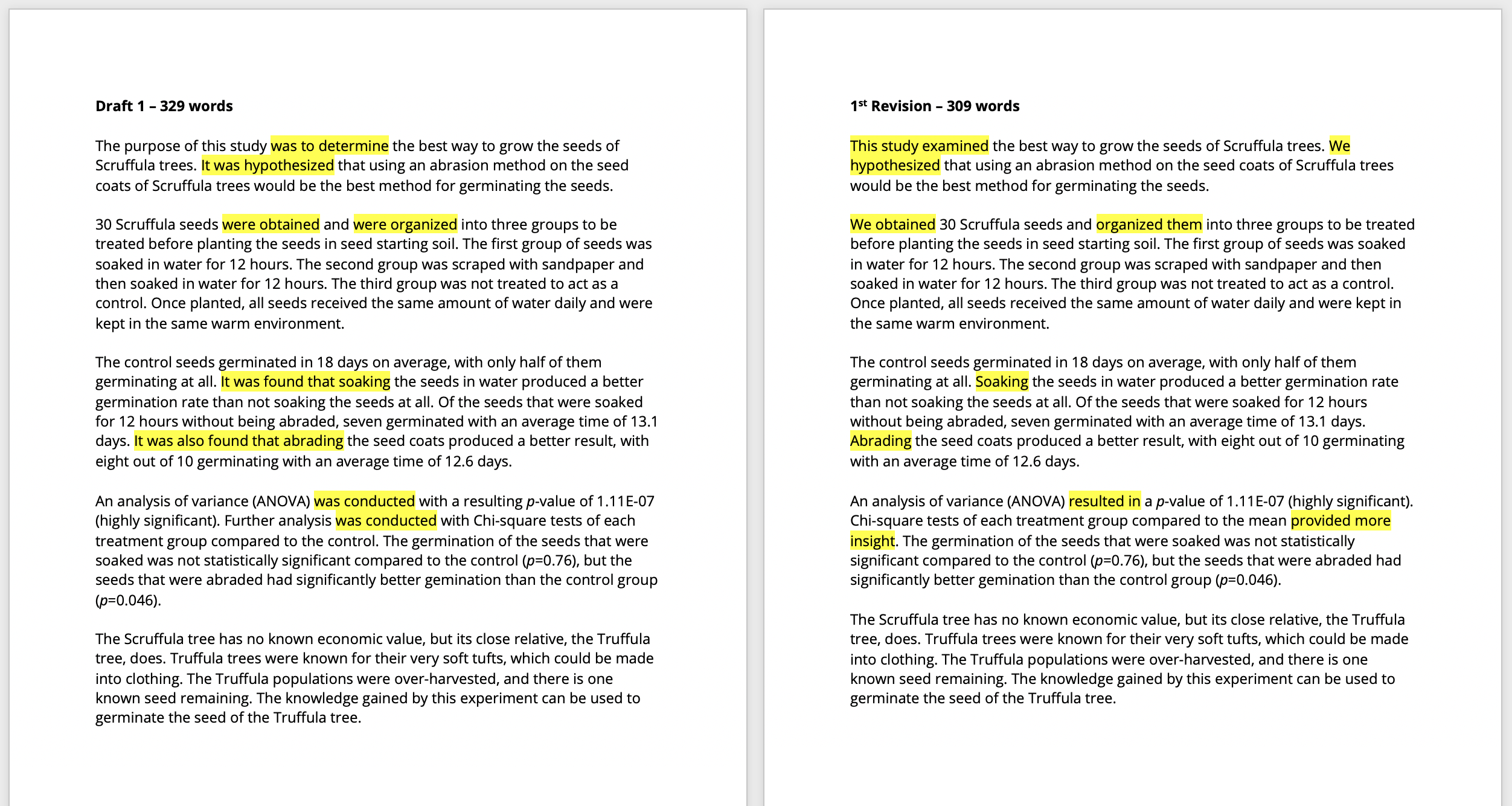
Let’s apply these tips to our abstract on Truffula seeds (below). On the left is our original abstract. On the right is our first edit.
Click on the image above to enlarge.
Tips 3 & 4: Jargon & Excessive Details
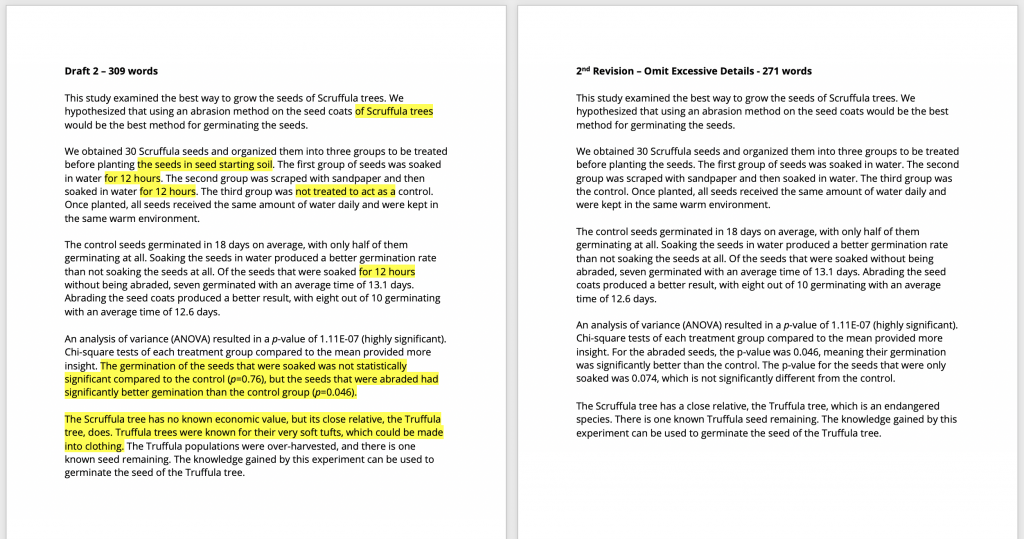
Let’s do a second edit of our abstract with tips 3 & 4 (below). On the left is our second draft. On the right is our abstract with the new edits.
Click on the image above to enlarge.
Tips 5 & 6: Readability & Proofreading
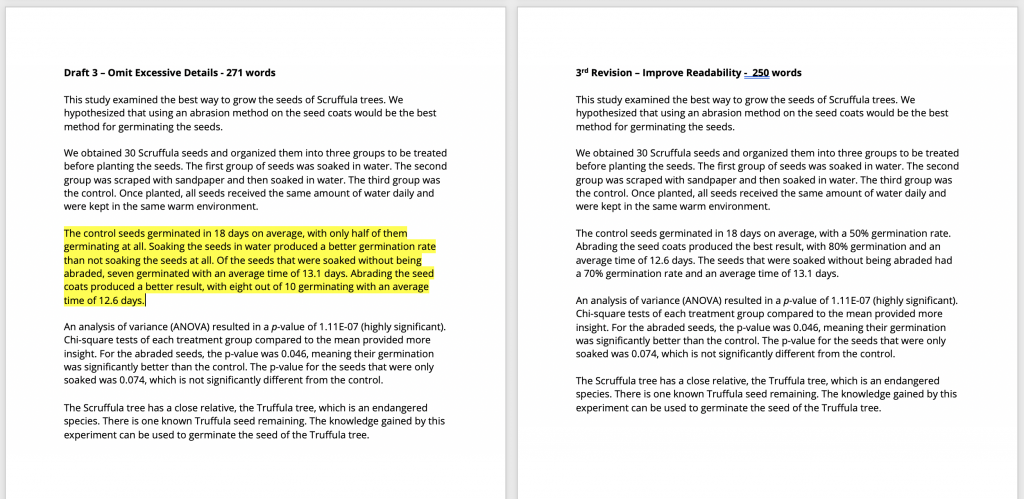
Let’s do a second edit of our abstract with tips 3 & 4 (below). On the left is our second draft. On the right is our abstract with the new edits.
Click on the image above to enlarge.
Final Draft
Here’s the final draft of our sample abstract.
This study examined the best way to grow the seeds of Scruffula trees. We hypothesized that using an abrasion method on the seed coats would be the best method for germinating the seeds.
We obtained 30 Scruffula seeds and organized them into three groups to be treated before planting the seeds. The first group of seeds was soaked in water. The second group was scraped with sandpaper and then soaked in water. The third group was the control. Once planted, all seeds received the same amount of water daily and were kept in the same warm environment.
The control seeds germinated in 18 days on average, with a 50% germination rate. Abrading the seed coats produced the best result, with 80% germination and an average time of 12.6 days. The seeds that were soaked without being abraded had a 70% germination rate and an average time of 13.1 days.
An analysis of variance (ANOVA) resulted in a p-value of 1.11E-07 (highly significant). Chi-square tests of each treatment group compared to the mean provided more insight. For the abraded seeds, the p-value was 0.046, meaning their germination was significantly better than the control. The p-value for the seeds that were only soaked was 0.074, which is not significantly different from the control.
The Scruffula tree has a close relative, the Truffula tree, which is an endangered species. There is one known Truffula seed remaining. The knowledge gained by this experiment can be used to germinate the seed of the Truffula tree.
In this lesson, you learned six tips for making your abstract a better piece of writing:
Now that you’ve written your abstract, let’s talk about your project’s title.
We use cookies to ensure that we give you the best experience on our website. If you continue to use this site we will assume that you are happy with it.