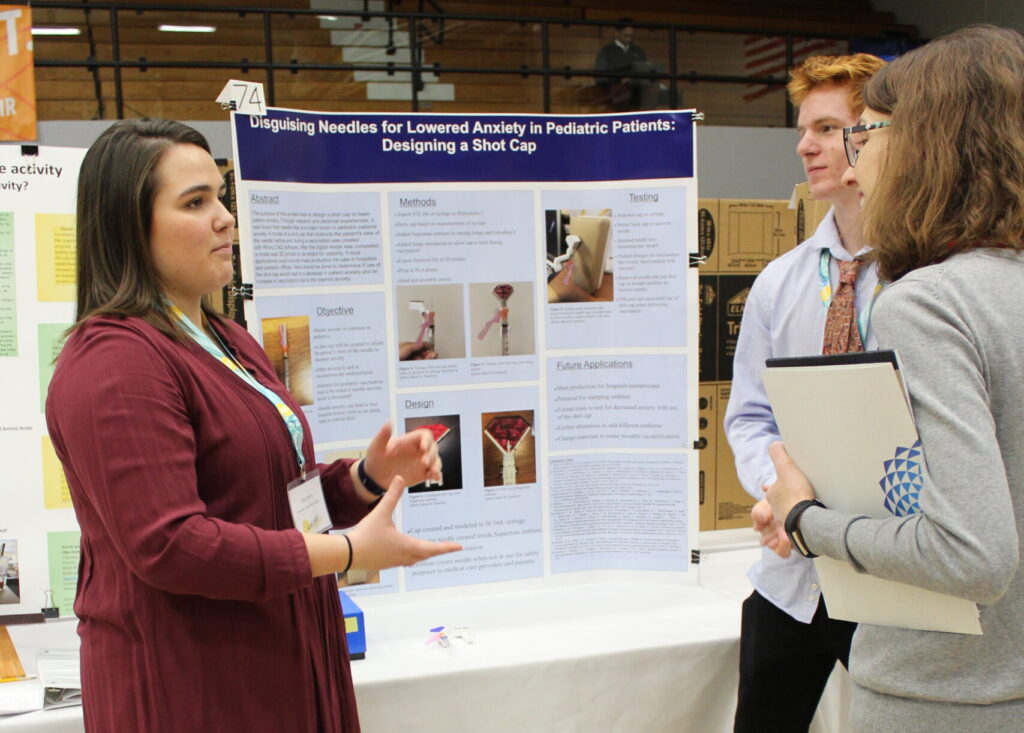
Human subjects research involves studying individuals to gain insights into human behavior, health, or experiences. It typically requires participants to provide consent and may involve surveys, interviews, or experiments. Engineering projects where participants test inventions must also follow the rules for human subjects research.
If you’re interested in this kind of research, you’re not alone! Behavioral Sciences is always one of the most popular categories at Maine State Science Fair. It provides a unique opportunity for you to explore and understand human behavior, health, and societal issues. Human subjects research allows you to do something that directly impacts you and your community, giving you a deeper connection to the world around you.
Lilley Harris and Blake Erhard developed a needle cover to help patients with a fear of needles.
Throughout history, human subjects research has played a pivotal role in advancing our understanding of the human condition. From ancient medical experiments to modern clinical trials, this practice has evolved. The Nuremberg Code in 1947 established ethical principles after the atrocities of World War II, leading to the development of guidelines such as the Belmont Report in 1979. These frameworks prioritize participant welfare, informed consent, and privacy.
In recent decades, technological advancements and increased collaboration have propelled human subjects research to new heights, enabling breakthroughs in medicine, psychology, and social sciences. Today, stringent regulations and ethical oversight ensure that research is conducted with integrity and respect for human rights.
We use cookies to ensure that we give you the best experience on our website. If you continue to use this site we will assume that you are happy with it.