Any strong science or engineering project is based on thorough background research. Early on, the literature review phase involves collecting data from reliable sources to understand your topic and identify gaps in knowledge. Staying current with recent scientific research is necessary for you to build knowledge and contribute to the scientific community.
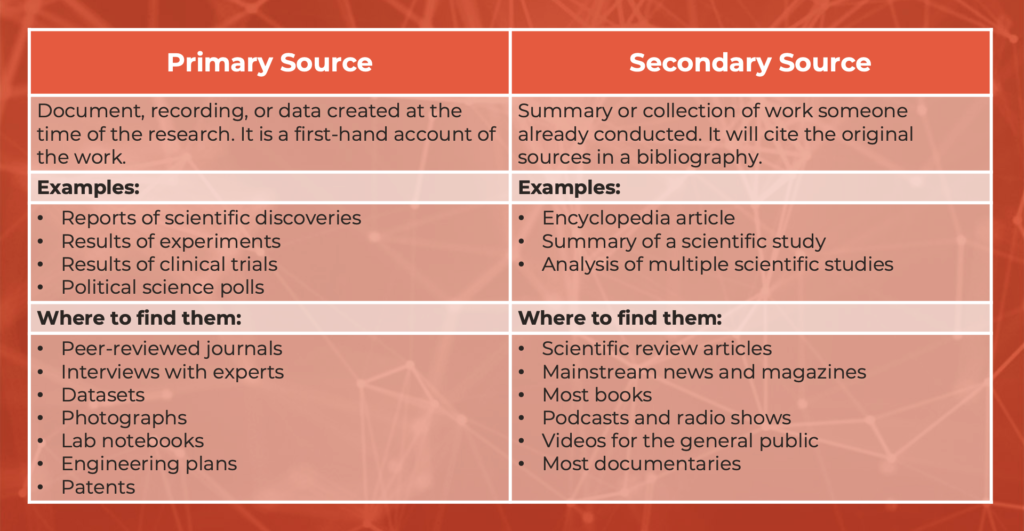
When you are researching your topic, you will see primary, secondary, and tertiary sources. You can learn more about this in our Conducting Background Research course.
While secondary sources are helpful for gathering basic information about your project, primary sources are the place to go for the most accurate scientific information. Secondary sources with bibliographies are also a good place to look for additional primary sources.
Recent research studies provide new ideas, methods, and discoveries. Using these makes your work more accurate and relevant while keeping up with current standards. It empowers you to tackle modern challenges, devise innovative solutions, and enrich your chosen STEM field. Addressing real-world issues gives your project purpose, impact, and societal relevance. All of this gives you the needed motivation to work through struggles for the sake of having a positive change in the world.
When you submit your project to the MSSF IRB, they will be looking for what makes your project different. Conducting research on human subjects is not something you should take lightly, and the IRB is there to weigh the benefits your project could have against the potential harm it could cause to your participants. The next lesson explains more on this topic.
Pro Tip!
Are you doing a survey project that uses a standard tool such as the Rosenberg Self Esteem Scale or the Perceived Stress Scale? If so, include these references in your bibliography. It’s also a good idea to put a short description of the tool in your survey so that your participants know it’s a tried-and-true set of questions.
True Story: The Facebook Emotional Contagion Study
Just a handful of the many moods available on Facebook
The Facebook Emotional Contagion Study, conducted in 2014, aimed to analyze the impact of emotional contagion on users’ emotions. Researchers manipulated the content in some users’ news feeds to display either positive or negative posts to observe if emotional states were influenced. Concerns arose due to the lack of informed consent and potential emotional harm to participants. The study raised ethical questions about online research and privacy, sparking debates on the responsibility of researchers when conducting studies on large social media platforms. It emphasized the need for transparent and ethical practices to protect user rights in human subjects research (source).
We use cookies to ensure that we give you the best experience on our website. If you continue to use this site we will assume that you are happy with it.